Stem Cell Malaysia
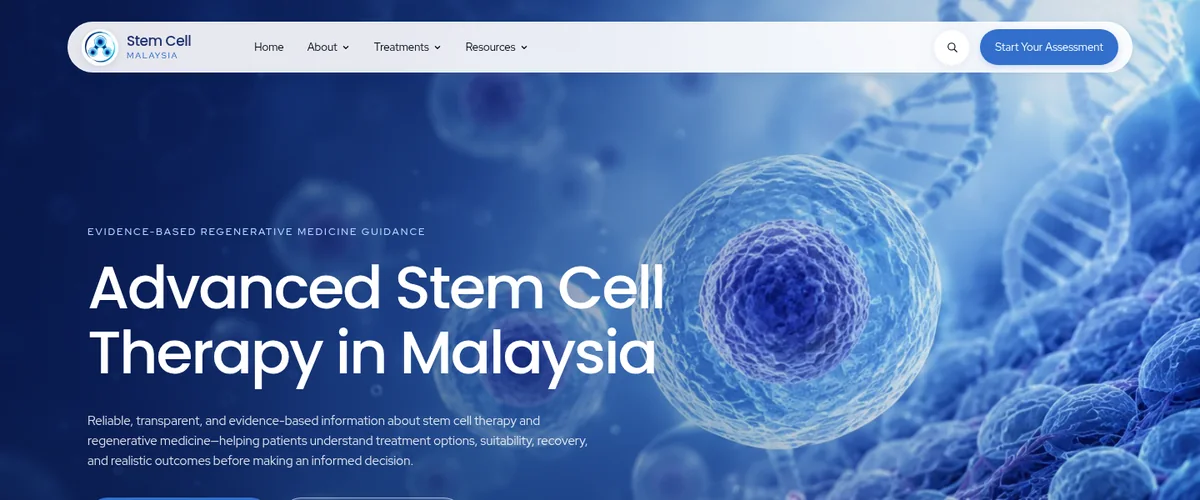
Stem Cell Malaysia is a 42-page website for a regenerative medicine clinic, built with Next.js and TypeScript. Rather than one page describing every treatment, the site gives each patient question its own URL — treatment pages, a cost page, a legality page, a clinic-verification page, and eleven educational articles — so each one can answer a single search intent completely.
- Role
- Full stack development, technical SEO
- Year
- 2025
- Stack
- Next.js, TypeScript, React, Tailwind CSS
The brief
Regenerative medicine is a high-consideration category. Nobody books a stem cell treatment from an advertisement. They research for weeks, and they research in fragments: what a treatment costs, whether it is legal in their country, how to tell a legitimate clinic from a dubious one, whether it helps the specific joint that hurts.
Those are not one question. They are a dozen questions with different intents, different urgency, and different stages of readiness to book. A single marketing page cannot serve them, because a page optimised for everything ranks for nothing and answers no question completely.
Mapping questions to URLs
The site architecture starts from the questions rather than from the clinic’s internal structure. Each recurring patient question was given its own page and its own URL, and the URL says what the page answers.
Treatment intent is served by dedicated pages for knee treatment, hair treatment, and facial treatment, alongside a treatments and conditions hub. Commercial research is served by a cost page. Trust and compliance questions — the ones that decide whether a patient proceeds at all — are served by a page on the legality of the therapy in Malaysia and a page on how to verify a clinic. Geographic intent is served by a Kuala Lumpur page.
That mapping means a search about cost and a search about knee treatment land on different pages, each of which covers its subject fully instead of devoting a paragraph to it. It also means the pages do not compete with each other for the same query, which is the failure mode of clinic sites that publish variations of the same content.
Trust content as its own layer
In medical categories the deciding factor is often not the treatment page at all. A patient who is not yet sure the field is legitimate will not read a treatment page carefully, no matter how good it is.
So compliance and verification content was treated as a first-class layer rather than a footnote. The legality page and the clinic-verification page exist to answer scepticism directly, in the patient’s own framing, and they link forward to treatments once that scepticism is addressed. Eleven educational articles sit around them, covering the research-stage questions that precede any treatment decision and linking inward to the relevant pages.
This is also what makes the site quotable. Self-contained pages that answer one question plainly are the pages that search engines — and increasingly AI assistants — extract answers from.
Rendering and crawlability
The site is built on Next.js with TypeScript and statically generated, so every page is delivered as complete HTML. For a medical site this matters more than the average case: content that only exists after JavaScript executes is invisible to crawlers that do not run it, and that category now includes several of the AI assistants patients ask before they ask Google.
All 42 URLs are declared in a sitemap at the site root, with consistent trailing-slash URLs so no page is reachable at two addresses. The URL structure is flat — one segment per page — which keeps every page within a short crawl path of the homepage and makes the URLs themselves readable in a search result.
Tailwind CSS handles the design system, which keeps the shipped stylesheet small and consistent across a site with many similar templates. TypeScript covers the content models, so a page cannot be published missing a field that its metadata or structured data depends on.